

The old playbook — dump $5,000 into Amazon PPC on day one and cross your fingers — is dead. The brands winning right now are running a completely different system.
Launching a new product in mid-2026 is harder than it's ever been. Competition is stiffer, Amazon fees keep climbing, and algorithm changes can tank a launch overnight. But here's the flip side: the opportunity is bigger than ever for sellers who play it smart. The brands hitting $10k–$50k in their first 30 days aren't relying on one channel or one big ad budget — they're running a coordinated multi-channel system that compounds.
Amazon still delivers scale. TikTok Shop gives you explosive product discovery with zero upfront ad spend. Shopify is where you actually own your customers and protect your margins from platform fee creep and algorithm whiplash. This guide covers the exact 10 strategies working right now — with specific tools, real cost breakdowns, and step-by-step execution for each one.
Read it once end-to-end, then bookmark it as a launch checklist. Each section maps to a specific phase: pre-launch (1–3), launch week (4–6), and weeks 2–4 (7–10). Work them in order. For a deeper dive on Amazon product research strategy, that guide is a great primer before you start.
Validate the idea with AI + cross-platform data first.
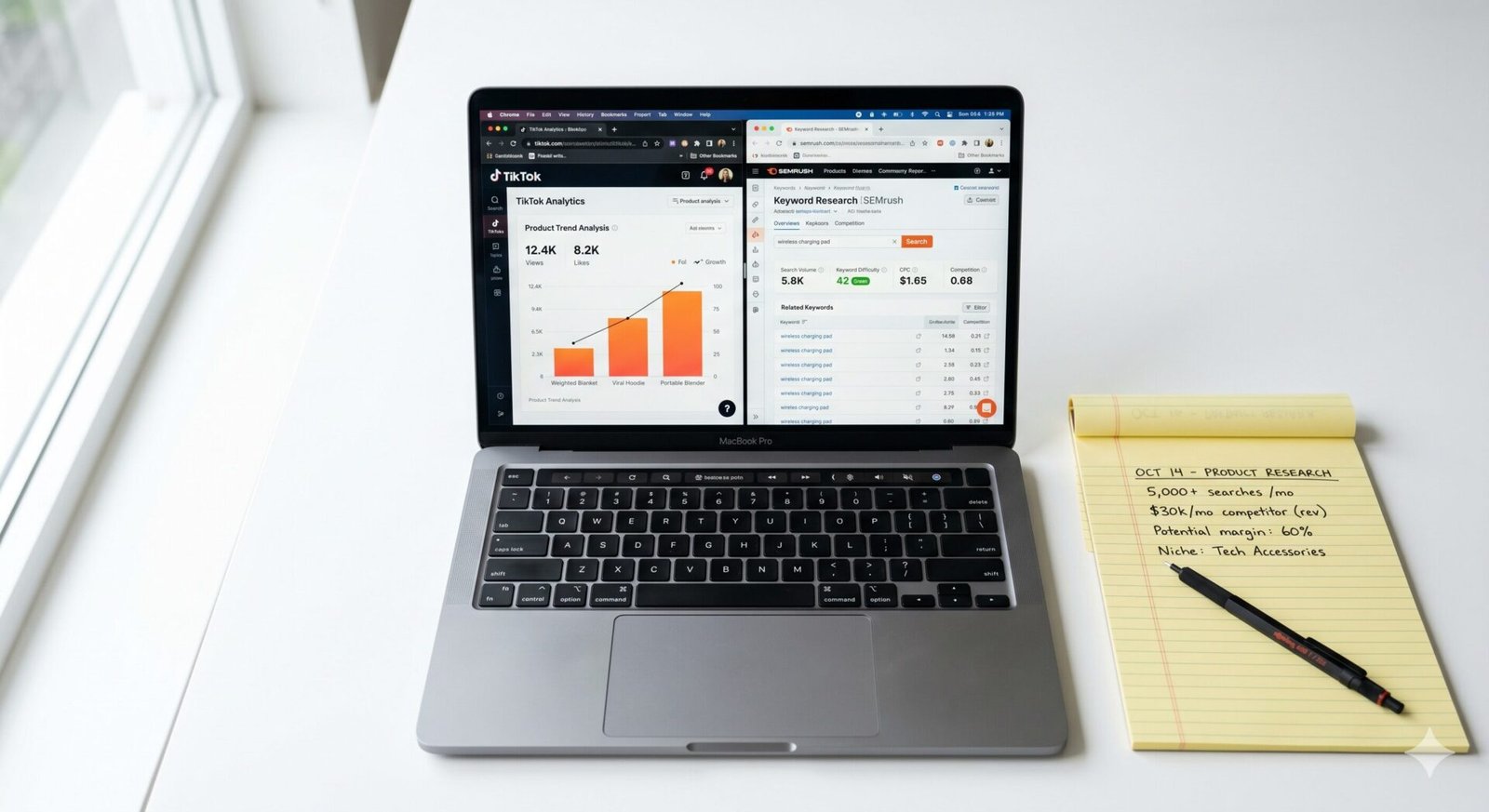
The biggest money-losing mistake in ecommerce is placing a 500-unit inventory order based on gut feeling. In 2026, that's not just risky — it's unnecessary. We have more free and low-cost data available at launch than ever before. Here's how to layer it.
The key insight is cross-platform validation: a product showing strong demand signals on both TikTok and Amazon is significantly less risky than one showing strength on only one. TikTok data tells you about content virality and buyer intent. Amazon data tells you about purchase intent and competitive landscape. When both align, you have a strong signal.
The 3-step validation stack
- TikTok discoveryTikTok Creative Center + Kalodata to find products with rising search volume and 500+ videos in the last 30 days. Look for products where view counts are rising month-over-month — that's the trend, not a spike.
- Amazon demand checkPull Search Query Performance in Seller Central or use Helium 10 Cerebro. Aim for 5,000+ monthly searches on your primary keyword and top listings earning $30k+/month. If a competitor is at $100k/month — even better, that's proof the market exists.
- AI synthesisPaste both datasets into Claude: "Analyze for demand strength, margin at $24.99, top 3 differentiation angles, top 3 launch risks, and estimated break-even timeline at a $4 cost of goods." You'll get a sharper brief in 90 seconds than most sellers produce in a day.
Before committing to inventory, run a focus group on your target customer — even a small paid panel of 10–15 people. The insight you get on pricing, packaging, and objections will sharpen every piece of content you create. The cost is usually $200–400 and it's one of the highest-ROI investments you can make at this stage.
Amazon is a drug — quick sales, low initial CAC, and then the fees climb until you realize you don't own a single customer relationship.
Set up all three channels from day one.
The biggest mistake we see from new brand owners is a single-channel launch. "I'll do Amazon first, then Shopify later." That later never comes, or it comes after 18 months of ceding every customer relationship to Amazon. Launch all three channels from the start — the operational overhead is minimal, the upside is massive.
Build Shopify as your central hub. Use a product sync app (LitCommerce, Shopify Marketplace Connect, or CedCommerce) to push your products to Amazon and TikTok Shop automatically. This keeps inventory counts, pricing, and product data consistent without manual updates. Once it's set up, maintaining all three channels costs you an extra 20–30 minutes per week.
What each channel is actually for
| Platform | Primary Role | What You Own | Week 1 Revenue % |
|---|---|---|---|
| Shopify | Brand hub + pre-sell | Customer email, phone, LTV | 30% |
| TikTok Shop | Discovery + organic velocity | Video content, affiliate network | 40% |
| Amazon | Scale + search intent | BSR rank, review velocity | 30% |
Shopify is your brand home. Amazon is your scale engine. TikTok Shop is your discovery rocket. Each plays a specific role — treat them as complementary, not competing. A sale on TikTok Shop should build your Amazon reviews. A Shopify pre-sale should fuel your Amazon launch. Everything compounds.
Let AI do 80% of the creative heavy lifting.
This is the single biggest structural shift from 2023 to 2026. A product launch that required $8,000–$12,000 in creative production three years ago — photography, video, copywriting, email design — now runs for under $600 with better output, faster turnaround, and more variants to test.
The key is building an AI creative stack that produces assets for all three platforms at once. Every brief, every shoot, every copy session should generate Amazon listing assets, TikTok video scripts, Shopify page copy, and email flows simultaneously. One input, four outputs. That's the leverage shift. For a deeper look at how AI-assisted video production works for Amazon listings, we've covered that in detail.
The AI content stack winning brands use right now
| Asset | Tool | Old Cost | New Cost | Status |
|---|---|---|---|---|
| Product photography (lifestyle + white bg) | Gemini Imagen / Flux | $2,500–5,000 | $30–80 | BEST ROI |
| UGC-style video (5–10 clips) | HeyGen / Arcads / Lapis | $1,500–3,000 | $99–299/mo | GAME CHANGER |
| Listing copy + A+ Content | Claude / ChatGPT | $800–1,500 | $20–40 | FAST |
| Email flows (6–8 sequences) | Claude + Klaviyo AI | $1,200–2,500 | $20–40 | FAST |
| TikTok scripts (30 short-form) | Claude / ChatGPT | $1,500+ | $10–20 | BEST ROI |
| A+ Content design (8 modules) | Canva AI + Claude | $1,000–2,000 | $50–100 | VERIFY OUTPUT |
One important note on A+ Content and EBC optimization: AI-generated modules still need a human to review keyword placement, layout compliance, and brand consistency before they go live — our 2026 Amazon listing checklist walks through exactly what to verify. The AI gets you 80% of the way there in minutes — the final 20% still needs your eye.
Drive first TikTok Shop sales with zero ad spend.
TikTok Shop is still the best zero-ad-budget launch channel in 2026. The reason is structural: the affiliate marketplace creates an army of content creators who actively want to promote new products, and the algorithm heavily rewards fresh product-focused content with organic reach that would cost $5,000+ to replicate with paid ads.
The playbook is simple. Focus on two things simultaneously: creator affiliates and consistent organic posting from your own account. Don't try to be polished — native, raw-feeling content outperforms produced ads by 3–5× on TikTok. The algorithm is looking for engagement signals, not production value.
Creator affiliate outreach protocol
- Build your target listUse TikTok Creator Marketplace to filter by niche, follower count (10k–500k is the sweet spot), and engagement rate. Bigger is not always better — a 30k-follower creator with 8% engagement beats a 300k creator with 0.8%.
- Send personalized video pitchesDM with a 30-second screen recording showing their content alongside your product. "I saw your review of [X] — I think [Your Product] would resonate with your audience." Acceptance rates triple compared to copy-paste outreach.
- Set commission at 15–25% + free samplesShip 20–40 units for creator samples in week one. Budget this into your launch cost. A creator who's actually used the product converts at 4–6× the rate of one who's just promoting from a spec sheet.
- Post 1–3 times per day from your own accountUse trending sounds, shoot in portrait, keep videos 15–45 seconds. Focus on "problem → product = solution" hooks. Track what hits in the first 72 hours and double down on that format.
Expect 10–15% of creators to accept your pitch, and 3–5% to actually post a video. This is normal and why you need to outreach to 100+ creators in week one. It's a numbers game — budget outreach time accordingly and don't take low response rates personally.
Pre-sell on Shopify to build your owned audience before launch.
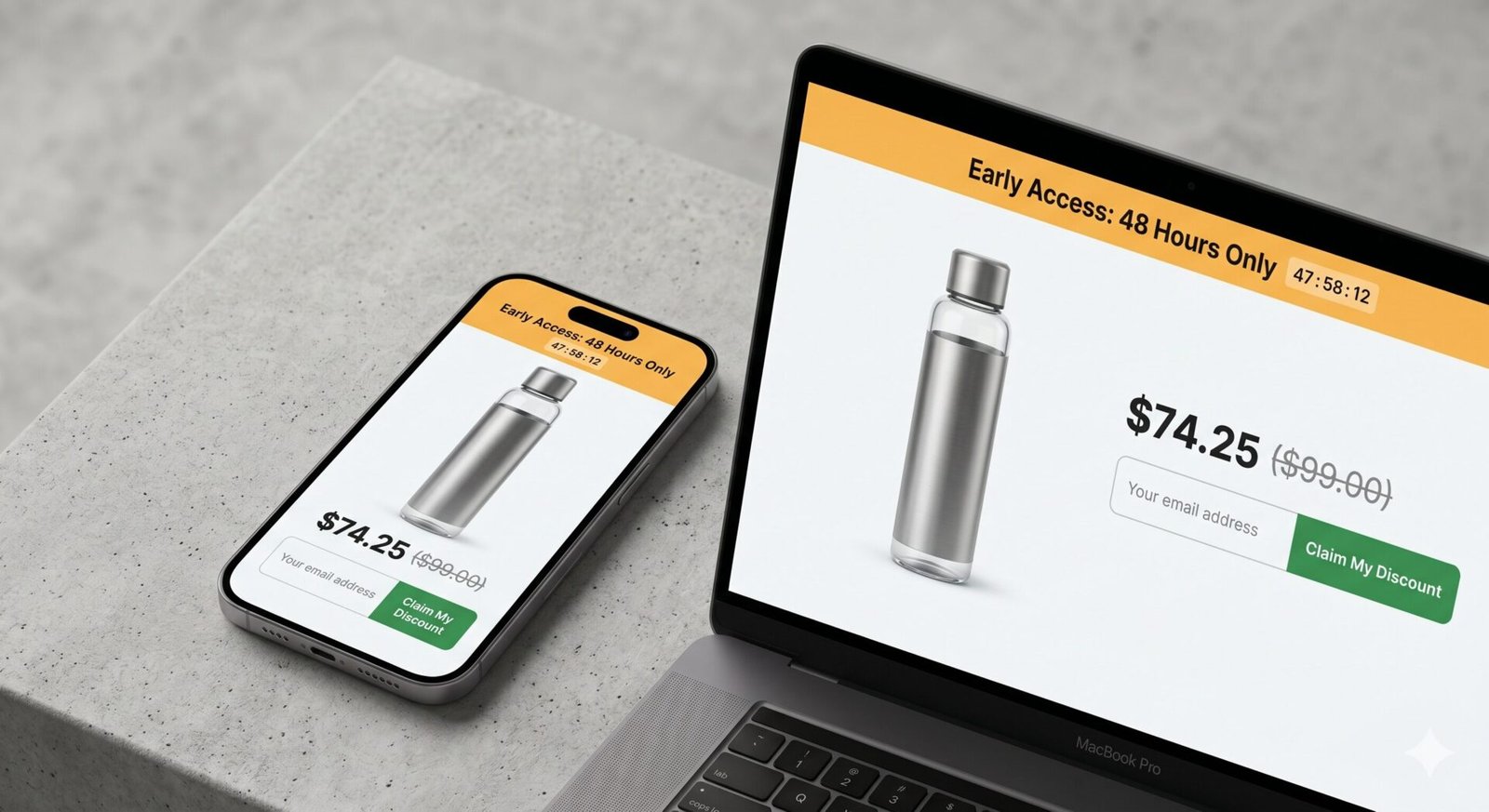
This is the single most underused tactic in ecommerce product launches, and it's the one that pays dividends for the entire life of your brand. Before you flip Amazon and TikTok Shop live, run a 7–14 day "Early Access" campaign on Shopify.
Offer your first 100–200 buyers a 20–30% discount in exchange for three things: their email address, their phone number (for SMS marketing), and an honest product review after delivery. Structure this as a genuine limited-time offer with a real countdown. Create urgency around the first-batch inventory, because it's real — you are doing a limited pre-launch run.
Why this one step transforms your launch
- Validates purchase intent with real moneyNot surveys, not wishlists — actual dollars. The truest signal you can get before placing your full inventory order.
- Builds owned marketing assetsEmail + SMS lists you use for every future launch. Not rented Amazon traffic that disappears when fees change.
- Seeds 50–100 genuine reviewsReal testimonials from verified buyers to deploy across Amazon, TikTok Shop, and your Shopify product page on launch day. This is your unfair advantage in week one.
- Creates a velocity spike on launch dayWhen you flip Amazon live, blast your pre-sell list for a 48-hour sales push. This is what triggers Amazon's algorithm to start ranking you organically — the algorithm rewards sales velocity, and you're engineering it on day one.
The Ecom Profit Box
Launch checklist, listing optimization, image blueprint, email strategy — 7 PDFs, completely free.
Get it free →Audit Your Launch Plan
Get exact next steps for Amazon, TikTok Shop, and Shopify — personalized to your product and budget.
Book now →Use smart low-cost external traffic tactics that actually convert.
Amazon's Brand Referral Bonus program is one of the most underutilized tools on the platform. It pays you back 10% of sales revenue generated from external traffic sources — effectively lowering your Amazon referral fee from 15% to ~5% for those orders. That alone makes external traffic worth pursuing even at break-even.
But don't send cold external traffic directly to a new Amazon listing with zero reviews. That traffic won't convert, and it signals poor listing performance to Amazon's algorithm. Route external traffic to a Shopify landing page first, warm them up with social proof, then direct them to Amazon. Conversion can double compared to cold landing.
The external traffic channels that work in 2026
| Channel | Cost | Best For | Time to Results |
|---|---|---|---|
| TikTok bio link | $0 | Driving Amazon clicks from organic content | Immediate |
| $0–50/mo | Home, kitchen, beauty, wellness products | 1–2 weeks | |
| Reddit (niche subs) | $0 | Authentic community discovery | 24–72 hours |
| Facebook Groups | $0 | Targeted niche audiences, high intent | 24–48 hours |
| Email list blast | $0 (owned asset) | Pre-sell audience → Amazon velocity spike | Same day |
| Google Shopping | $200–500 test budget | High purchase-intent shoppers | 3–5 days |
Don't send cold external traffic directly to a new Amazon listing with zero reviews. Route to a Shopify warming page first. Also: disclose properly in any community or group posts — Reddit and Facebook moderators will remove promotional content that isn't transparent about being from the brand.
Get reviews fast — without faking a single one.
Reviews remain the single biggest conversion lever and the single biggest launch bottleneck on Amazon. Pair this with our Amazon review strategy guide for the full system. This hasn't changed. What has changed is that Amazon's fake review detection has gotten dramatically better in 2025–2026. Incentivized or purchased reviews will get your listing suppressed — sometimes your entire account. Don't risk it. Here's the legitimate playbook.
The 4-part review acceleration system
- Enroll in Amazon Vine$200. Up to 30 honest reviews from vetted Amazon reviewers. Do it the day your listing goes live — Vine reviews take 2–4 weeks but are the most trusted reviews on the platform.
- Send samples to TikTok affiliatesBudget 20–40 free units for creators. Ask them to leave an Amazon review in addition to their TikTok content. Not required, not incentivized — just asked nicely. Many will do it.
- Post-purchase email sequence on ShopifySend at day 5 (checking in on shipping) and day 10 (asking if they love it + gentle review ask). Keep it warm, human, and non-pushy. These convert at 8–15%.
- Amazon "Request a Review" automationUse Helium 10 or Jungle Scout to auto-send the official Amazon review request for every order. This is fully compliant, costs pennies, and converts at 5–10% of all orders.
At a 7% review rate on 200 week-one orders = 14 reviews. Combined with 30 Vine reviews, you're at 44 reviews by week 3. That's enough to start converting cold Amazon traffic at a healthy rate — and enough for PPC to be worth turning on. Reviews are a math problem, not a mystery.
Cross-promote between all three channels — every single day.
This is the compounding multiplier that separates $10k launches from $50k launches. When all three channels are live and talking to each other, every piece of content you create does triple duty. A TikTok video drives Amazon reviews and Shopify email signups. An Amazon review gets repurposed into a Shopify testimonial and a TikTok creator brief. A Shopify email drives TikTok follows and Amazon purchases.
The cross-platform flywheel
The closed loop works like this: TikTok Shop organic content drives discovery → drives Amazon reviews → Amazon reviews drive Shopify social proof → Shopify email list drives Amazon velocity spikes → Amazon velocity drives organic rankings → organic rankings drive more Amazon sales and TikTok content ideas. Each element feeds the others. Once it's spinning, it's very hard to stop.
Every week: produce 1 long-form product video. Chop it into 5–7 TikTok clips. Use stills as Amazon and Shopify images. Pull quotes for email. Turn one good customer review into a testimonial graphic for all three platforms. One source, 20+ assets.
For analytics on how each channel is performing and where competitors are seeing traction, tools like SellerSprite's Ads Insights give you a real-time view of keyword competition and BSR movement that informs your TikTok content strategy as much as your Amazon PPC.
Use AI for dynamic pricing and inventory alerts.
Going out of stock in weeks 2–4 is one of the most damaging things that can happen to a new product launch. Amazon's algorithm interprets stockouts as poor launch performance and can take weeks to recover ranking from. Meanwhile, you've spent real money driving external traffic to a listing that can't fulfill orders.
The solution is an AI-powered monitoring system that alerts you early. Tools like Keepa and DataHawk monitor competitor pricing in real time. Custom Zapier → Claude → Slack integrations can flag when a competitor drops price by 15%+, when your BSR movement warrants a pricing adjustment, or when your inventory runway drops below 21 days.
The $30/month monitoring stack
- Keepa$20/month. Tracks competitor pricing, BSR, and review velocity for every ASIN you're watching. Set up alerts for any BSR movement in your top 5 competitors.
- Zapier$10–20/month. Triggers on Keepa data → sends summary to Claude for interpretation → posts recommendation to Slack. One afternoon to build, runs forever.
- Amazon Seller Central inventory planningFree. Set reorder alerts at 30 days of supply. For a new launch, that means reordering when you hit 300 units if your daily velocity is 10+ units/day.
Total cost: $30–40/month. Time to build: one afternoon. Time saved: 2–3 hours/week of manual monitoring. More importantly, catching a competitor price drop in real time and adjusting within 24 hours vs. 5 days can mean the difference between holding your BSR position or losing it.
Track profit — not revenue — from day one.
Revenue is vanity. Profit is sanity. With Amazon's fluctuating fee structure, TikTok Shop's commission payouts, Shopify's subscription and transaction fees, plus the cost of samples, Vine, and creator gifting — you can easily run a "successful" launch that loses money on every unit. Most sellers don't realize this until month three.
Build a blended P&L from launch day. Track revenue, COGS, Amazon fees, TikTok commission payouts, Shopify fees, ad spend, and the fully-loaded CAC across all three channels. The most important number is your blended net margin per unit — if that's positive and improving week-over-week, you're on the right track.
The 6-metric launch dashboard
| Metric | Definition | Target (week 4) |
|---|---|---|
| Blended TACoS | Total ad spend ÷ total revenue (all channels) | <15% |
| Net profit per unit | Selling price – COGS – fees – ad spend per unit | >$4–6 |
| Total reviews (all platforms) | Amazon + TikTok Shop + Shopify combined | 40+ |
| BSR trend | Amazon Best Seller Rank, category | Improving weekly |
| Email + SMS list size | Combined owned subscribers | 200+ |
| % sales from Shopify | Shopify orders ÷ total orders across all channels | >25% |
If you track nothing else: Blended TACoS · Net profit per unit · Total reviews · BSR trend · Email list size · % Shopify. Five numbers. Look at them every Monday. If net profit per unit is improving and Shopify % is growing, you're building something durable — not just a temporary Amazon ranking you'll lose the second your PPC stops.
Frequently Asked Questions.
How much money do I actually need to launch a product in 2026?
A tight but properly-executed launch runs $3,000–$7,000 total. Here's how that breaks down:
Inventory: $1,500–3,500 (200–500 units at $5–8 COGS). Amazon Vine: $200. AI creative tools: $200–400 (one-time plus monthly). Creator samples: 20–40 free units (~$150–300 product cost). Shopify setup: $29–79/month. Contingency/flash sale discounts: $200–500.
If your budget is under $3,000, prioritize the Shopify pre-sell, TikTok organic, and Vine. Skip Google Shopping and paid ads entirely until you're cash-flow positive.
Should I launch on all three platforms at the same time?
Yes — but stagger the execution. Week 1–2 before launch: Set up Shopify and run the pre-sell campaign to build your email list and collect initial reviews. Launch day: Flip Amazon and TikTok Shop live on the same day. Blast your pre-sell email and SMS list for a 48-hour velocity spike. This coordinated approach is what triggers Amazon's algorithm.
Do I still need Amazon PPC in 2026?
Yes — but not on day one. Starting PPC before you have 10–15 reviews and a CVR above 8% is burning cash on a listing that can't convert cold traffic. Wait until week 2–3, start with exact-match on 3–5 high-intent keywords, and scale from there. The review threshold isn't arbitrary — Amazon's algorithm uses CVR as a quality signal, and a new listing with no reviews will never convert cold traffic at a rate that makes PPC profitable.
What's the single biggest mistake new brands make when launching in 2026?
Treating Amazon as their entire business. Single-channel Amazon brands are one policy change, one suspension, or one fee increase away from disaster. The brands that build durable, profitable businesses treat Amazon as one revenue channel among three, with Shopify as the foundation that houses customer relationships and protects long-term margins.
How long until a new product launch becomes profitable?
Most brands hit blended profitability (across all three channels combined) by week 4–6. Shopify pre-sell is profitable almost immediately since you're selling at full price to warm, pre-qualified buyers. TikTok Shop hits profitability around week 2–3 once organic content has traction. Amazon takes longest — typically week 4–8 — because of the review ramp-up period before organic ranking kicks in.
How do I choose between Amazon, Shopify, and TikTok Shop if I have a limited budget?
Start with TikTok Shop and Shopify. They have the lowest upfront cost (no inventory minimums, no Vine fees), and TikTok Shop's affiliate model means you're only paying commissions on actual sales. Build your email list on Shopify. Once you have reviews and testimonials from those first sales, add Amazon with enough inventory to sustain a 30-day velocity push.
What products are hardest to launch with this playbook in 2026?
Products over $80 are harder on TikTok Shop (impulse buy threshold drops significantly above that price point). Products with complex assembly or usage are harder to demonstrate in 15–45 second TikTok videos. Products in hyper-competitive Amazon categories (like supplements or phone cases) need significantly more review velocity and differentiation to move the needle. The playbook still works — it just requires more of everything.
Can I use AI product images on Amazon, or will they get flagged?
As of 2026, Amazon permits AI-generated product photography as long as it accurately represents the physical product — no misleading claims, accurate colors, no composite product features that don't exist. The key is that the images must show the actual product, not a hypothetical version. Run all AI images through a human review before uploading. Misleading imagery is an immediate listing removal risk regardless of how it was produced.
What's the role of email marketing in a new product launch?
Email is the backbone of your owned-channel strategy. Your pre-sell campaign builds the list. Your launch-day blast creates the velocity spike. Your post-purchase sequences generate reviews and repeat purchases. Long-term, the email list you build during launch is your most durable asset — it can drive Amazon velocity spikes any time you need a BSR boost, fund future product launches, and generate Shopify revenue that doesn't depend on any algorithm.
How do I handle inventory risk if TikTok Shop goes viral unexpectedly?
Have an "out of stock" contingency plan before launch. Options: (1) set up a Shopify waitlist form that captures emails for when stock returns — you recapture demand instead of losing it; (2) negotiate a fast-reorder timeline with your manufacturer before launch day (get written confirmation of 21-day production for a reorder); (3) consider Amazon FBA + FBM hybrid so you can fulfill from home inventory if Amazon stock runs low. Viral stock-outs are a good problem — but only if you capture the demand signal rather than losing it.
Is it worth building a Shopify store if I'm mainly an Amazon seller?
Yes — and the ROI compounds over time. The argument isn't that Shopify will outsell Amazon in year one (it usually won't). The argument is that the email list, customer relationships, and margin protection you build on Shopify make your entire business more durable, more valuable, and less dependent on Amazon's decisions. Every brand that's been suspended or hit by a fee increase wished they had invested in their owned channel earlier. Start building it now, even if Amazon is 90% of your revenue today.