Most ecommerce advice in 2026 will tell you to spend more — more on ads, more on influencers, more on tools. But the brands that are actually winning right now are doing something different.
They’re growing revenue and increasing net profit at the same time, without burning out or blowing the budget.
These five strategies are built around leverage, positioning, and control. They don’t require more hours. They require smarter decisions.
If you run an Amazon brand, a Shopify store, or both, every one of these applies to you. Let’s get into it.
Strategy #1: Increase Pricing Power Through Differentiation
If your brand looks and sounds like every other brand in your category, you’re going to compete on price. And competing on price is a losing game — it compresses margins, erodes brand value, and makes you disposable.
The fix isn’t a price increase. The fix is differentiation.
What differentiation actually means:
- Stronger, more intentional branding
- Clearer messaging that speaks directly to your target customer
- Content that explains why your product is different — and who it’s for
When your customer clearly understands what makes your product the right choice for them, price sensitivity drops. You can raise prices without killing conversion. And when conversion stays stable while prices rise, net profit increases immediately — without touching traffic.
🔑 The Real Takeaway
Brand value and pricing power are directly connected. Every dollar you invest in better branding, better content, and clearer messaging is a dollar that compounds into higher margins over time.
BONUS: Differentiation also strengthens your SEO positioning. When your brand is clearly defined, you build branded search volume — people searching specifically for you, not just the category. That’s free, high-intent traffic that compounds over time.
Strategy #2: Shorten the Time It Takes a Customer to Make a Buying Decision
Friction kills sales. Every second a potential customer spends confused, second-guessing, or trying to figure out what you’re actually selling is a second they’re drifting toward a competitor.
The goal is simple: a shopper should be able to watch one short video, look at one strong infographic image, and be 90% convinced your product is the solution to their problem.
How to eliminate buying friction:
- Simplify your benefits — cut the jargon, lead with the outcome
- Address objections before they come up — anticipate hesitation and disarm it in your content
- Guide customers toward one clear action: buy now, or move on
- Use video content on listings and product pages to answer the questions customers are too lazy to read
Faster buying decisions = higher conversion rates. Higher conversion rates = better organic rankings on Amazon. On Shopify, it means lower cost per acquisition and better ROAS. Both feed net profit without touching your ad budget.
🔑 The Real Takeaway
Clarity is king. Every piece of content you create — images, video, copy — should be doing the job of shortening the gap between ‘discovery’ and ‘purchase.’ If it doesn’t serve that goal, it’s noise.
BONUS: This principle applies to your email sequences too. If a welcome flow takes seven emails before it asks for the sale, you’re leaving money on the table. Get to the point. Respect the customer’s time.
Strategy #3: Monetize Existing Demand More Efficiently
New traffic is expensive. Existing customers are not.
An existing customer already trusts you. They already bought. They’ll most likely find you again through their order history or by searching your brand name. That means the cost to re-acquire them is near zero — and yet most brands ignore them entirely after the first purchase.
Ways to monetize existing demand:
- Introduce subscriptions — even in categories where they seem like a stretch, test it
- Build post-purchase email flows that introduce complementary products
- Create bundles that increase average order value (AOV)
- Run win-back campaigns for customers who haven’t bought in 60–90 days
The math is straightforward: every additional purchase a customer makes lowers your effective customer acquisition cost (CAC). If you spent $20 to acquire a customer and they buy three times, your real CAC is $6.67 per order. That directly increases net profit without increasing ad spend.
🔑 The Real Takeaway
The easiest sale is always the second one. Build systems that make re-purchasing effortless — subscriptions, loyalty programs, smart automations — and watch your profit margins improve without touching traffic.
BONUS: On Amazon, the Subscribe & Save program is a built-in version of this strategy. If you’re not enrolled and your product is a repeat-purchase item (supplements, consumables, household goods), you’re leaving recurring revenue on the table.
Strategy #4: Reduce Profit Leaks Across the Customer Journey
Most brands lose money quietly. Not in one big catastrophic event — but in a slow, steady drain of refunds, support tickets, returns, and stale content that no longer converts.
These are profit leaks. And they compound.
The most common profit leaks to fix:
- Refunds caused by unmet expectations — your product page over-promised
- Support ticket volume that eats team bandwidth — preventable with better FAQs and product education
- Stale listing content that no longer reflects the product or market — do a content audit
- Poor packaging or product quality that drives returns — address root causes, not just returns policy
The fix is always the same: better communication and more accurate expectation-setting upfront. Improve your product education content. Be specific about what your product does and doesn’t do. Address the most common complaints before they become returns.
On Amazon, fewer refunds protect your seller metrics and your rankings. Better reviews follow. And every refund you prevent is pure margin recovery — money back in your pocket without touching a single ad.
🔑 The Real Takeaway
Profit protection is just as valuable as profit growth. Audit your refund rate, your top support ticket topics, and your listing content quarterly. The leaks are usually hiding in plain sight.
BONUS: Set up a simple customer satisfaction survey post-purchase. Two questions: ‘Did the product meet your expectations?’ and ‘Is there anything we could improve?’ The answers will tell you exactly where your content or product is falling short — before it shows up in your return rate.
Strategy #5: Design the Business to Be Acquisition-Friendly From Day One
This one changes how you make every decision.
Most ecommerce operators build their business to survive. The ones who build it to be sold — even if they never plan to sell — end up making dramatically better decisions along the way.
What acquisition-friendly looks like:
- Clean, organized financials that a buyer (or investor) can understand at a glance
- Predictable, recurring revenue — subscriptions, repeat purchase rates, email list revenue
- Clear Standard Operating Procedures (SOPs) so the business doesn’t depend on you personally
- A brand with real equity — not just a commodity product on a platform
Buyers pay higher multiples for businesses that are easy to understand and easy to operate. When you build with an exit in mind, risk goes down naturally. You stop making decisions that are clever in the short term but create complexity in the long run.
Value goes up. Stress goes down. And if you ever do decide to sell, you’re ready.
🔑 The Real Takeaway
The discipline required to build an acquisition-ready business is the same discipline that makes a business more profitable and less stressful to operate. Build it right from the start.
BONUS: If you’re on Amazon, start building off-platform revenue now — Shopify, email list, owned audience. Buyers in the aggregator space increasingly value brands that aren’t 100% dependent on Amazon. Diversification is both a growth strategy and an exit strategy.
Putting It All Together: The Monthly Review Framework
These five strategies only work if you execute them intentionally and measure the results. Here’s the monthly review framework to keep yourself accountable:
- Pricing & Differentiation — Did conversion rate hold or improve? Did AOV increase?
- Buying Decision Speed — Did you update any content? Did conversion rate move?
- Existing Demand Monetization — What’s the repeat purchase rate? Is the email list working?
- Profit Leak Reduction — What’s the refund rate? Top support ticket topics? Any content to refresh?
- Business Health Score — Are SOPs documented? Financials clean? Revenue diversified?
Review these monthly. Test changes. Go back to the data. That’s the loop that compounds.
Bonus: The Mindset That Makes All 5 Work
Every one of these strategies is built on the same foundation: treating your ecommerce business like a real business, not a side hustle.
That means clean systems. Intentional decisions. Measured outcomes. And the discipline to review and adjust — monthly, not annually.
Growing revenue is achievable when you have a plan and you test it. Growing profit while building a business that’s valuable enough to sell one day? That takes discipline. But the operators who get there aren’t smarter than you — they’re just more consistent.
Ready to Execute? Grab the Free Ecom Profit Box
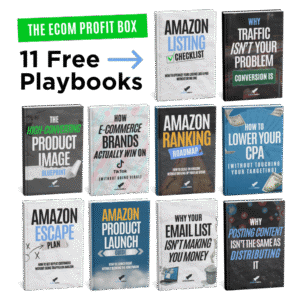
If you want step-by-step playbooks to implement all five of these strategies the right way, Ian Smith at Evolve Media has put together a free resource called the Ecom Profit Box.
Inside you’ll find:
- 10 step-by-step guides built specifically for Amazon sellers
- Guides covering listing optimization, content split testing, product launches
- TikTok growth, Shopify traffic, email list building
- How to turn content into profit — the full system
- A free one-on-one Zoom call with Ian to audit your brand and give you direct, actionable feedback
Get the free Ecom Profit Box at
About Ian Smith & Evolve Media
Ian Smith is the founder of Evolve Media Agency, a global Amazon creative agency headquartered in Colorado Springs, CO. Evolve Media helps Amazon sellers increase clicks and conversions through high-quality listing content, AI-assisted product photography, and data-driven growth strategy.
The agency serves clients across the US, Canada, the UK, and beyond — specializing in conversion-driven creative that gets results.