

Meta commands 68% of total ecommerce advertising budgets in 2026. That is not because every brand running Meta ads is profitable — it is because the brands that have figured out how to run Meta ads profitably are spending heavily and winning market share while their competitors complain that the platform does not work anymore.
Meta does work. The brands failing on Meta in 2026 are almost always making the same identifiable mistakes: running the Pixel without the Conversions API, measuring ROAS at 30 days on products with 90-day repeat purchase cycles, scaling before the learning phase is complete, and — most commonly — spending money on creative that was never going to convert and blaming the audience targeting when the real problem was the ad itself.
This guide fixes all of that. If you are building a Shopify channel alongside your Amazon business, Meta ads are the fastest way to drive your first customers. If you are already running Meta ads and frustrated by the results, this guide will tell you exactly what to fix first and in what order.
⚡ The core principle from our Lower CPA guide: Fix ads in this exact order — Hook, Visual, Message, Offer. If the hook fails, nothing else matters. A strong offer cannot save a weak hook. A clear message cannot save an ignored visual. Fix what people see first. This order works because people decide whether to keep watching in the first 1-2 seconds — before copy, before offers, before branding.
📊 Is Meta Still Worth It for Shopify in 2026?
The honest answer is yes — but with meaningfully reset expectations compared to 2019 or even 2021. Apple’s iOS privacy changes broke attribution. Cold audience CAC has risen 2.5-3x since 2021. CPMs hit $13.48 median in the US and climb to $23+ in competitive categories during Q4. You cannot expect the same results with the same strategy you used four years ago.
What has not changed: Meta still reaches 3 billion people across Facebook and Instagram. Its targeting data, even post-iOS, remains the most sophisticated audience intelligence available in paid social. Advantage+ Shopping Campaigns deliver 22% higher ROAS than manual campaign structures. And critically — if you are building a Shopify brand, Meta is still the most cost-effective channel for driving first-time buyers at scale, provided you have the creative quality and landing page experience to convert the traffic you are paying for.
The brands winning on Meta in 2026 have made three critical shifts: they measure 120-day cohort ROAS instead of 30-day window ROAS, they treat creative as their primary optimization lever rather than audience targeting, and they run the Conversions API alongside the Pixel for accurate data. Get those three things right and Meta delivers. Skip them and you will keep wondering why the platform “stopped working.”
🔒 Fix This First: The Conversions API
If you are running Meta ads in 2026 and relying solely on the browser Pixel for conversion tracking, you are flying blind. Apple’s ATT framework means approximately 30-50% of iOS conversions go completely unattributed without server-side tracking. Meta’s algorithm optimizes toward conversions — if it cannot see half of them, it is optimizing toward an incomplete signal and your campaign performance degrades silently over time.
The Conversions API (CAPI) sends purchase and conversion events directly from your Shopify server to Meta’s servers, bypassing Apple’s tracking limitations entirely. It is not optional in 2026. It is the foundation that everything else sits on. The good news: if you are on Shopify, setting it up takes under 30 minutes.
- Install via Shopify’s native Meta integration Go to Shopify Admin → Sales Channels → Facebook & Instagram. Connect your Meta Business account and enable the Conversions API toggle. Shopify handles the server-side event passing automatically. No developer required.
- Verify in Meta Events Manager Go to Meta Business Manager → Events Manager → your Pixel. Check the Event Match Quality score for your Purchase event. A score of 6+ is good. Below 5 means your customer data matching is weak and needs attention.
- Enable Advanced Matching In Events Manager, turn on Automatic Advanced Matching. This allows Meta to match conversion events to user profiles using hashed email addresses and phone numbers, significantly improving attribution accuracy on iOS devices.
- Set your attribution window correctly In your Meta Ads Manager settings, set attribution to 7-day click, 1-day view. Do not use 28-day click attribution for optimization — Meta’s algorithm performs best with the 7-day window. Use your Shopify analytics and UTM data for true multi-touch attribution analysis separately.
⚠️ Duplicate event warning: When you enable CAPI alongside your browser Pixel, you may see duplicate Purchase events in Events Manager. This is normal. Meta’s deduplication logic handles it automatically as long as you are passing the same event ID from both sources. Check your Event Deduplication score in Events Manager to confirm it is working correctly.
🏗️ Campaign Structure: How to Set Up Meta for Shopify
The simplest effective campaign structure for most Shopify brands in 2026 is a three-layer funnel: prospecting, retargeting, and retention. Each layer has a different audience, a different creative approach, and a different ROAS expectation. Running all three simultaneously gives your ad account a self-sustaining growth loop.
Advantage+ Shopping Campaigns (ASC) or broad targeting with creative as the signal. Lookalike audiences from your buyer list (1-3%). Budget: 60-70% of total. ROAS expectation: 1.5-3x at 30 days, 3-5x at 120 days. Goal: cost-efficient new customer acquisition and list building.
Website visitors (last 14-30 days), video viewers (75%+), Instagram engagers (last 60 days), Add-to-Cart non-purchasers. Budget: 20-30% of total. ROAS expectation: 4-8x. Goal: close buyers who showed intent but did not convert on first visit. Use social proof and urgency creative here.
Email list from Klaviyo synced as a Custom Audience, past purchasers 30-180 days, high-value customers (top 20% by AOV). Budget: 10-15% of total. ROAS expectation: 6-10x. Goal: cheapest revenue you will ever generate — re-engaging people who already trust your brand.
Advantage+ Shopping Campaigns: Should You Use Them?
Advantage+ Shopping Campaigns (ASC) are Meta’s AI-driven campaign type that automates audience targeting, creative testing, and budget allocation. In 2026, ASC delivers 22% higher ROAS than manually structured campaigns on average, and Meta recommends it as the default for ecommerce. For most Shopify brands, it is the right starting point.
ASC works best when: you have at least 50 purchase events per week giving the algorithm a strong conversion signal, your creative library has 5+ active variations for the algorithm to test, and you have at least 30 days of purchase history in your ad account. If you are launching from zero, start with a manual Sales campaign for the first 30-60 days to build the conversion history, then migrate to ASC once you have sufficient data.
📊 2026 Benchmarks by Placement and Vertical
Know your numbers before you judge your performance. Here are the real 2026 benchmarks so you can tell whether your campaigns are above average, at average, or need work:
| Placement | Avg CPM (US) | Avg CPC | Best For |
|---|---|---|---|
| Facebook Feed | $7.47 | $1.06 | Conversion campaigns, static image, carousel |
| Instagram Feed | $6.25-$7.68 | $3.35 | Visual brands, lifestyle imagery, high-AOV products |
| Instagram Stories | $6.25-$7.68 | $1.83 | Most cost-efficient CPC, urgency offers, limited-time |
| Instagram Reels | Lowest CPM | Variable | Upper funnel awareness, UGC video, creator content |
| Facebook Marketplace | Low | Low | Home goods, electronics — surprisingly strong ROAS |
| Vertical | Median ROAS | Median CPA | Median CTR |
|---|---|---|---|
| Beauty & Skincare | 3.5-4.5x | $28-$45 | 2.8-3.1% |
| Home & Garden | 3.8-4.3x | $35-$55 | 2.6-2.9% |
| Health & Wellness | 3.0-4.0x | $32-$50 | 2.2-2.6% |
| Fashion & Apparel | 2.5-3.5x | $30-$48 | 2.4-2.8% |
| Electronics | 2.0-3.0x | $50-$90 | 1.8-2.2% |
| Food & Beverage | 1.5-2.5x | $20-$35 | 2.0-2.4% |
| Ecommerce Average (all verticals) | 2.98x | $38.17 | 2.19% |
⚠️ Q4 reality check: These are annual averages. Q4 CPMs run 26% above the annual average, and Black Friday week sees CPMs 2-3x normal levels. A campaign hitting 3x ROAS in August can drop to 2x ROAS in November at identical budget levels if you do not adjust for the seasonal cost increase. Build a quarterly budget calendar and plan for Q4 inflation in advance.
🎨 Creative Is Your Primary Lever — Not Targeting
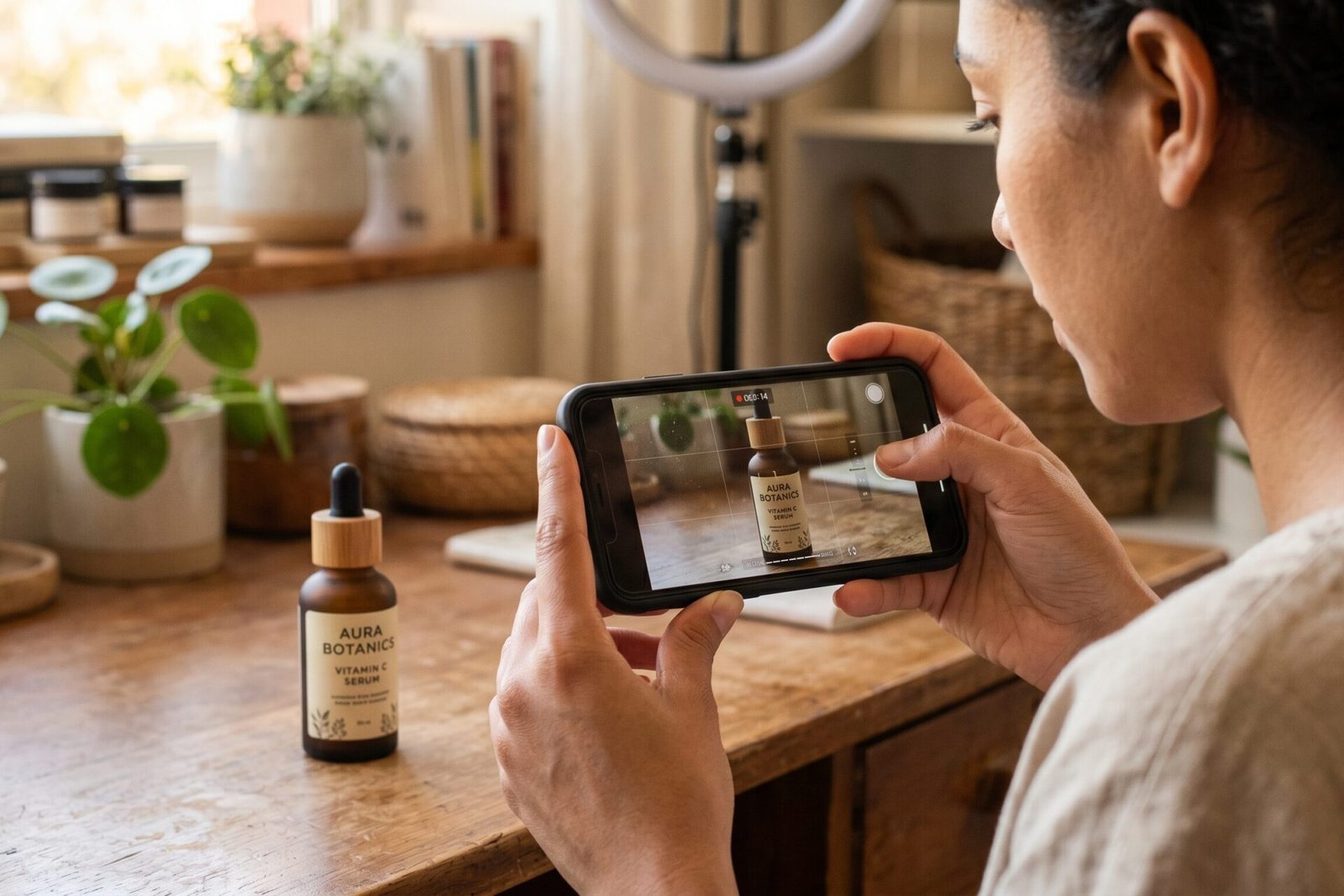
This is the most important shift in Meta advertising since iOS. Before 2021, audience targeting was the primary lever — find the right interest stack, the right demographic, the right lookalike, and the creative was almost secondary. Post-iOS, with audience data degraded and Meta’s algorithm shifting toward broad optimization, creative has become the targeting.
Here is how it works: when your ad goes live, Meta shows it to a sample of people within your broad audience. The platform watches who stops scrolling, who watches past 3 seconds, who clicks, who buys. Based on those early engagement signals, it builds a profile of who your buyer is and finds more people who match that profile. If your creative sends clear, consistent signals about who it is for, Meta optimizes toward the right people automatically. If your creative is confusing, generic, or unclear, Meta gets mixed signals and your CPA climbs while delivery stagnates.
This is why two brands can target the exact same audience and see wildly different CPAs. The difference is not the audience — it is the quality of the signal the creative is sending. Fix the creative first. Always. Per our CPA reduction framework: hook, visual, message, offer — in that exact order.
🔥 The Hook Framework: Stop the Scroll in 3 Seconds
The hook is the first 1-3 seconds of your ad — the moment that determines whether someone keeps watching or scrolls past. Everything after the hook assumes the viewer is still there. If the hook fails, your offer never gets seen, your message never lands, and your spend is wasted. Most brands spend 80% of their creative time on the body of the ad and almost none on the hook. It should be the reverse.
Works because it creates immediate self-identification. Only the people who have that exact problem keep watching — which means every subsequent view is a qualified prospect. Drives lower CPA than broad hooks because the audience self-selects for relevance.
Pattern interrupt that creates immediate curiosity. Viewers stay to understand how the result was achieved. Works especially well for beauty, health, home, and fitness categories where the outcome is visually demonstrable.
Leverages third-party validation immediately. Viewer trust is established before the product is even shown. Customer speaking to camera converts better than brand speaking to camera in most categories.
Stops the scroll through cognitive dissonance. Viewer wants to know why their current approach is wrong. Works well for products with a genuine category differentiation story. Requires a strong payoff or credibility drops fast.
Creates open loop tension that the brain wants to resolve. Works well for health, beauty, and supplement categories. Must pay off quickly — curiosity that leads to confusion raises CPA. The reveal must happen within 10-15 seconds.
Simple but effective for highly specific audiences. The narrower the audience definition in the hook, the better it converts with the right people. Trade-off: it repels everyone outside that definition, which can limit scale.
🎬 Ad Formats That Convert for Shopify in 2026
Not all ad formats perform equally for ecommerce, and the right format depends on your product category, your creative assets, and where in the funnel you are running the campaign. Here is what the data shows:
- UGC-style video (highest converting for most categories). Authentic, creator-style videos shot on phone convert 2-3x better than polished brand video on CTR across Meta platforms in 2026. The audience has developed strong ad blindness to anything that looks like a commercial. Content that feels native to the platform — real person, natural lighting, genuine opinion — bypasses that filter. Our product video team shoots specifically for this format.
- Static image (fastest to test, strong for retargeting). Do not underestimate static images. They load instantly, perform well in Feed placements, and are significantly cheaper to produce than video. For retargeting audiences who already know your brand, a clean static image with a strong offer often outperforms elaborate video. Test static images first when you need to move fast.
- Carousel (best for multi-product and AOV focus). Shows multiple products or multiple angles of one product in a swipeable format. Works well for fashion, home goods, and beauty brands with broad product lines. Each card is its own conversion opportunity. Use carousels for warm retargeting audiences who have viewed multiple products.
- Collection ads (best for product discovery). Opens into a full-screen Instant Experience when tapped. Excellent for driving exploration of a product catalog. Works best on mobile Instagram Feed where the immersive format is most impactful. Higher friction than direct-to-product-page ads but drives higher intent from the people who engage.
- Reels (best CPM for awareness, growing conversion). Reels offer the lowest CPM on Meta which makes them ideal for upper-funnel prospecting and building retargeting audiences cheaply. Conversion rates from Reels are lower than Feed placements currently, but Reels viewers who later convert via retargeting often have higher AOV. Use Reels to fill the top of your funnel at low cost.
💡 Creative fatigue rule: Beauty and fashion creatives fatigue in 5-7 days. Home goods and health products last 10-14 days. Always have 3-5 new creatives entering testing simultaneously so you never find yourself scaling a fatigued ad. The top-performing brands on Meta test 15-20 new creative variations per month. When CTR drops more than 20% week over week, the creative is fatiguing — replace it before CPA climbs.
Need help with Meta ad creative or management?
We produce UGC-style video, static ads, and manage full Meta campaigns for Shopify brands scaling from first sale to $100K+ monthly.
🌐 Audience Strategy: Cold, Warm, and Retention
With Meta’s algorithm now doing most of the heavy lifting on audience discovery, your job has shifted from building intricate interest stacks to giving the algorithm the right inputs and getting out of its way. Here is the audience approach that works in 2026:
Cold Prospecting Audiences
- Advantage+ broad targeting. For most Shopify brands, running ASC with minimal audience restrictions and letting Meta’s algorithm find buyers delivers better results than manually stacked interest targeting. The algorithm uses its own purchase intent and behavioral data to find your buyer. Your only job is to give it great creative to work with.
- Lookalike audiences from buyers (1-3%). Upload your Shopify customer email list as a Custom Audience and create 1%, 2%, and 3% lookalikes. These are statistically the most similar people to your existing buyers. Test 1% for highest precision and 3% for higher volume. Exclude existing customers from all prospecting campaigns.
- Broad interest targeting (backup, not primary). Interest targeting still works as a complement to broad and lookalike approaches, but rarely outperforms them as a standalone strategy in 2026. Use it to test new audience angles when lookalike performance plateaus.
Warm Retargeting Audiences
- Website visitors (last 14-30 days). Everyone who visited your Shopify site without purchasing. Segment by page visited for more relevant creative — product page viewers get product-specific ads, homepage visitors get brand awareness retargeting.
- Add-to-Cart / Checkout Initiated non-purchasers. Your hottest retargeting audience. These people showed clear purchase intent. Use urgency creative — limited stock, time-sensitive offer, social proof. Convert these before they go to Amazon.
- Video viewers (75%+ watch time). Anyone who watched 75% or more of your video ads has shown strong interest. Retarget with a direct conversion ad featuring the product they watched. This audience converts at 3-5x the rate of cold traffic.
🚫 The Landing Page Problem Nobody Talks About
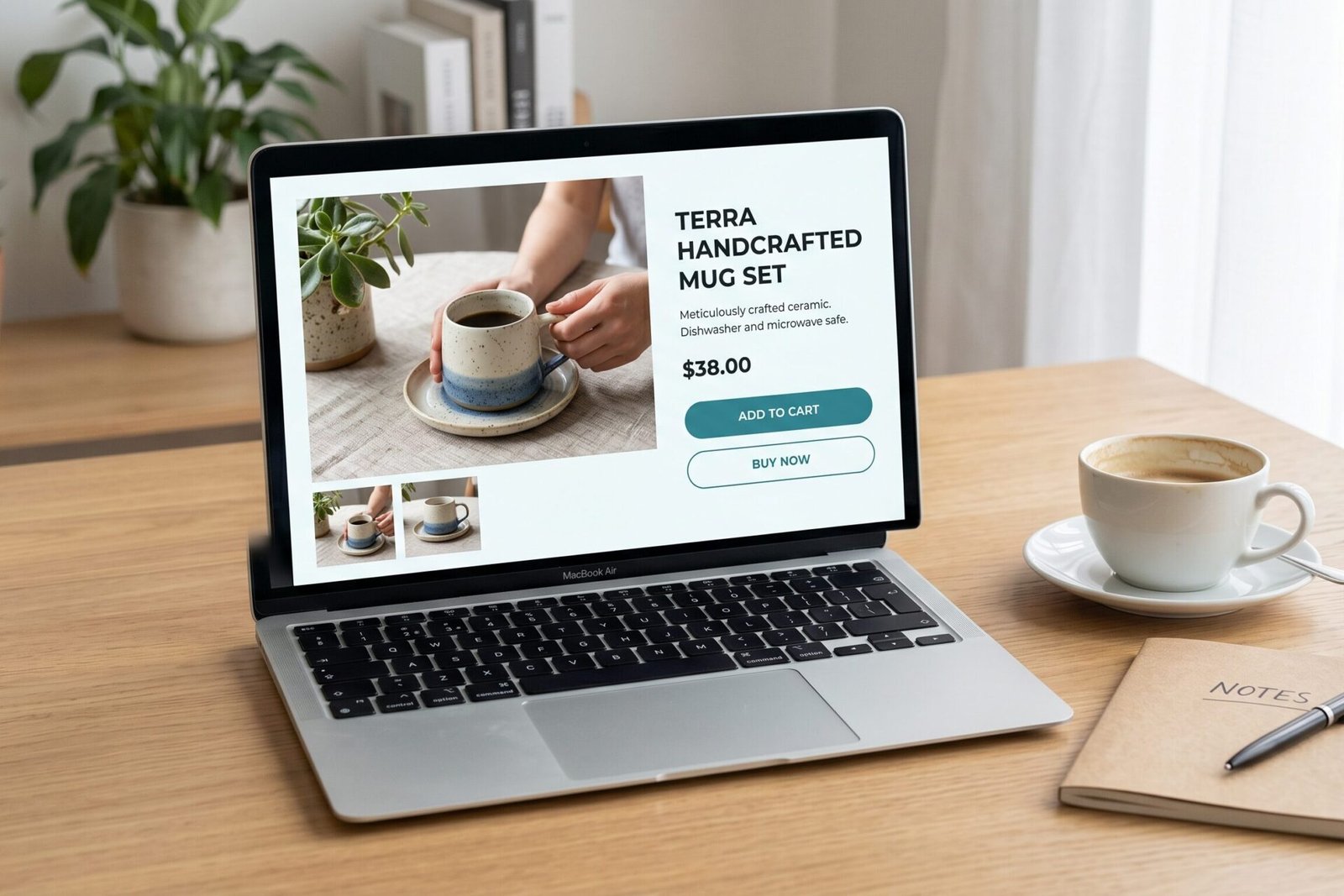
Here is the uncomfortable truth that most Meta ad guides skip entirely: a great ad sending traffic to a weak product page produces the same terrible CPA as a mediocre ad sending traffic to a great page. Both conversion rates multiply together to produce your final cost per acquisition. If your Meta ad has a 3% CTR but your Shopify product page converts at 1.5%, you are paying for 67 clicks to get one sale. Fix the page and you cut that to 33 clicks.
As covered in depth in our Traffic Isn’t Your Problem, Conversion Is guide — traffic amplifies whatever is already on the page. More Meta spend on a page converting at 1.5% just produces more expensive non-conversions. The page must be fixed first. Our Shopify build team optimizes specifically for this.
What a High-Converting Shopify Product Page Needs
- Hero image passes 3-second rule — immediately clear what it is and who it is for
- Free shipping banner visible above the fold on every page
- Price, reviews count, and star rating visible without scrolling
- 50+ reviews with photo/video reviews prominent
- Clear, benefit-led product description — not feature bullet points
- Lifestyle imagery showing the product in real use
- FAQ section answering the top 5 objections
- Upsell or bundle offer visible on the product page (AI-driven product recommendations can compound this lift further)
- Email capture pop-up active (10-15% off first order)
- Mobile-optimized — 70%+ of Meta traffic arrives on mobile
💵 Budget Math: What to Spend and When to Scale
Budget Framework by Stage
🔥 Testing Stage
📈 Scaling Stage
📊 Budget Allocation
📈 Attribution and Measurement: Reading the Numbers Right
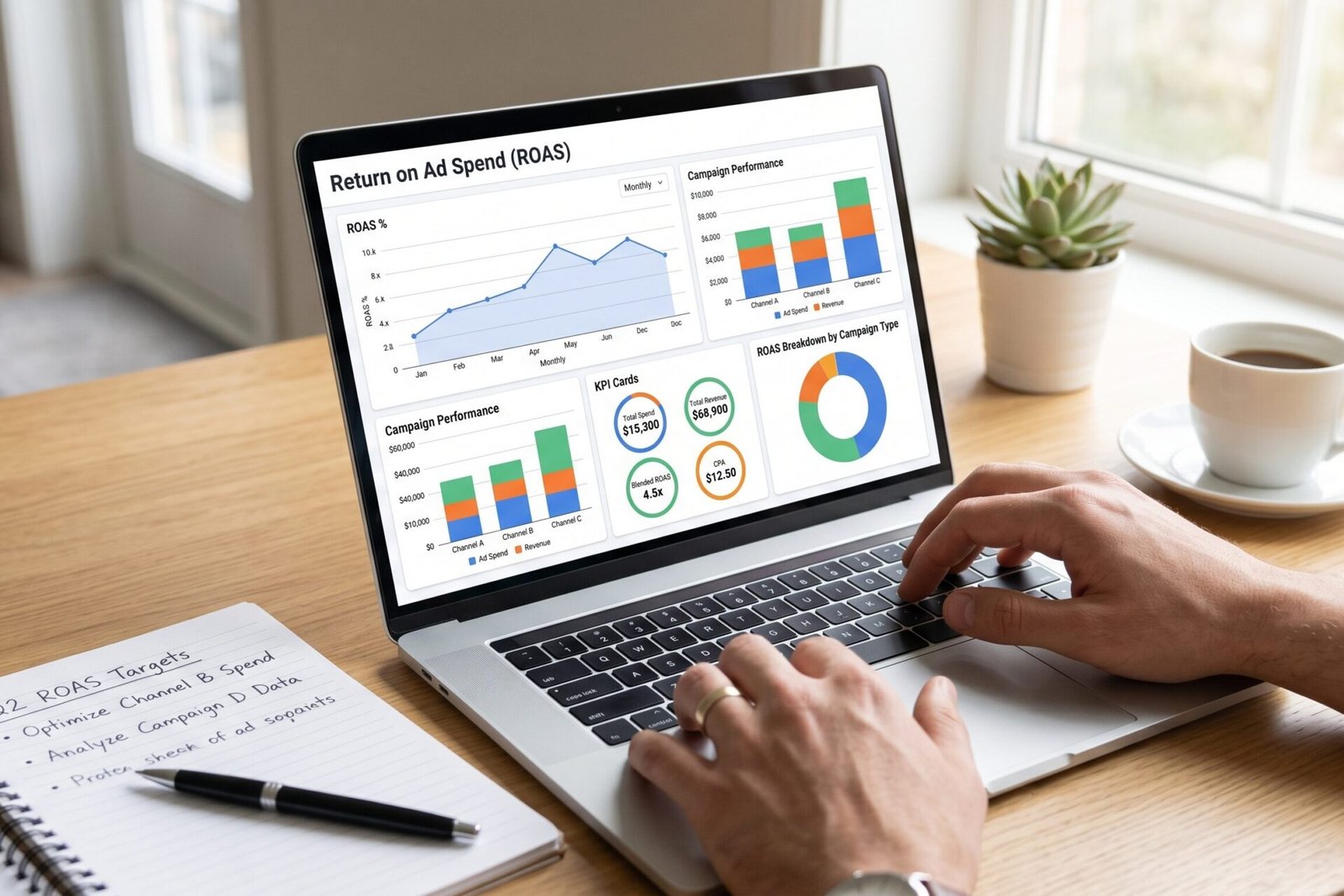
The biggest analytical mistake Shopify brands make with Meta ads is measuring ROAS at 30 days and making scaling or killing decisions based on that number. For products with repeat purchase cycles of 60-120 days — supplements, skincare, consumables, apparel — 30-day ROAS severely underestimates campaign value. You kill profitable campaigns because you are measuring the wrong window.
The 120-day cohort method: tag every Meta campaign with UTM parameters in Shopify (utm_source=meta, utm_campaign=campaign-name). Pull your Shopify customer source data at 30 days, 60 days, and 120 days for each cohort. A campaign that looks like 1.8x ROAS at 30 days can be 5.6x ROAS at 120 days when repeat purchases and subscription renewals are counted. Kill campaigns only if 120-day cohort ROAS is below 2x, not if 30-day ROAS looks soft.
Your North Star Metric: MER Over ROAS
Marketing Efficiency Ratio (MER) is total revenue divided by total ad spend across all channels. It tells you the blended return on your entire paid marketing investment — without being confused by attribution window games, cross-channel overlap, or platform-reported numbers. If your MER is 4x, every $1 you spend on ads returns $4 in revenue across all channels. Track MER weekly in a simple spreadsheet alongside your Shopify revenue and total ad spend. It is the most honest single number available to you.
Track ROAS at the campaign level for optimization decisions. Track MER at the business level for budget allocation decisions. They serve different purposes and both matter.
💌 Meta + Email: The Most Powerful Ecommerce Stack
Meta drives the first purchase. Email owns every purchase after that. The two channels are not competing — they are compounding. Brands that run Meta and Klaviyo together consistently outperform brands running either channel alone, because Meta fills the top of the funnel and email converts the repeat purchases at near-zero cost.
Here is how to connect them strategically in line with our Shopify vs Amazon guide’s owned channel framework and the principles in our Amazon Escape Plan ebook:
- Sync your Klaviyo list to Meta as a Custom Audience. Every subscriber in Klaviyo becomes a retargeting audience in Meta. Run retention ads specifically to this warm audience at 10-15% of your total budget. These are the cheapest conversions you will ever generate.
- Run Meta lead gen campaigns to grow your Klaviyo list, then plug those subscribers into a strong welcome and post-purchase flow sequence. Meta Lead Ads capture email addresses directly in the app with a native opt-in form. Use these to build your list faster with leads that flow automatically into Klaviyo. Cost per lead via Meta Lead Ads is typically $2-8 — which pays for itself on the first repeat purchase.
- Use Meta to re-engage email-unresponsive subscribers. Segment subscribers who have not opened emails in 90+ days and run Meta ads to that Custom Audience. Paid ads often reach people who have disengaged from email and can reactivate them into the purchase funnel at a much lower cost than acquiring a new customer.
- Your email list makes your Meta ads more efficient. Brands with strong owned email channels have significantly lower Meta CAC because email handles repeat purchases that would otherwise require paid re-acquisition. A $50 first-purchase CAC on Meta is highly profitable when email drives 3 more purchases from that customer at $0 acquisition cost. Our email marketing services set this entire system up.
🍻 Seasonal Strategy: When to Test, When to Scale, When to Pull Back
| Quarter | CPM Level | Strategy |
|---|---|---|
| Q1 (Jan-Mar) | Lowest of year — 15-20% below annual avg | Front-load creative testing. New Year intent buyers are active and CPMs are the cheapest they will be all year. Test 10-15 new creative variations. Build your retargeting audiences cheap. This is your best acquisition window. |
| Q2 (Apr-Jun) | Moderate | Scale your Q1 winners. Seasonal moments: Mother’s Day (beauty, home, gifts) and Father’s Day. Continue adding new creative to prevent fatigue. Build your proven creative library for Q4. |
| Q3 (Jul-Sep) | Moderate — rising | Back-to-school for relevant categories. Begin pre-qualifying Q4 creative — start testing holiday angles in September. Lock in your top 5-10 winning creatives that you will scale in Q4. |
| Q4 (Oct-Dec) | 26% above avg. BF/CM week 2-3x normal | Scale proven Q1-Q3 winners with higher budgets. Do NOT test new untested creative in Q4 — you will pay premium CPMs to learn what you could have tested cheaply in Q1. Front-load October spend before peak CPMs. Consider pausing on Black Friday and resuming on Cyber Monday when CPMs briefly dip. |
🚫 The Most Common Meta Ads Mistakes in 2026
- Changing targeting before fixing creative. The #1 mistake. If your hook is weak, no audience on earth will make it perform. The algorithm reacts to creative first. Fix the hook, visual, copy, and offer before you touch a single audience setting.
- No Conversions API. Running Pixel-only tracking in 2026 means 30-50% of conversions are invisible to Meta’s algorithm. It is optimizing toward a degraded signal and your performance suffers silently. Set up CAPI via Shopify’s native integration today — it takes 30 minutes and immediately improves campaign optimization.
- Measuring only 30-day ROAS. For any product with a repeat purchase cycle longer than 30 days, 30-day ROAS is misleading. You will kill campaigns that are actually profitable at 120 days. Set up UTM tracking in Shopify and measure cohort ROAS at 30, 60, and 120 days before making scaling or killing decisions.
- Sending traffic to a weak product page. A great ad sending traffic to a page converting at 1.5% gives you the same terrible CPA as a weak ad. Fix your Shopify product page before scaling ad spend. Email capture must be live, social proof must be visible above the fold, and free shipping must be prominent on every page.
- No creative refresh cadence. Running the same creative for 30+ days in beauty and fashion categories means you are scaling a fatigued ad. Budget for 3-5 new creative variations entering testing every 2 weeks. The brands with the best Meta performance test 15-20 new creatives per month.
- Scaling before the learning phase is complete. The learning phase requires approximately 50 conversion events per ad set. Scaling budget aggressively before hitting this threshold resets the learning phase and degrades delivery. Be patient for the first 7-14 days, especially on new campaigns.
- Not excluding existing customers from prospecting campaigns. You are paying prospecting CPMs to reach people who already bought from you. Add your Klaviyo email list and recent purchasers as exclusions on all cold prospecting campaigns. Reach existing customers through your much cheaper retention campaigns instead.
"The brands winning on Meta in 2026 did not find a magic audience or a secret campaign structure. They fixed their creative, set up server-side tracking, and stopped measuring their campaigns at 30 days. Everything else followed from those three decisions."