Most ecommerce brands discover they're invisible to AI the worst possible way — watching a competitor get recommended in ChatGPT for a query they should own. The problem started months earlier, in gaps they never knew existed.
AI search visibility isn't a traffic source you can monitor in Google Analytics. It isn't captured by rank tracking software. It doesn't show up in your bounce rate or session data. And because it's invisible to conventional analytics, most brands don't know they have a problem until a customer tells them a competitor's name came up when they asked an AI assistant for a recommendation.
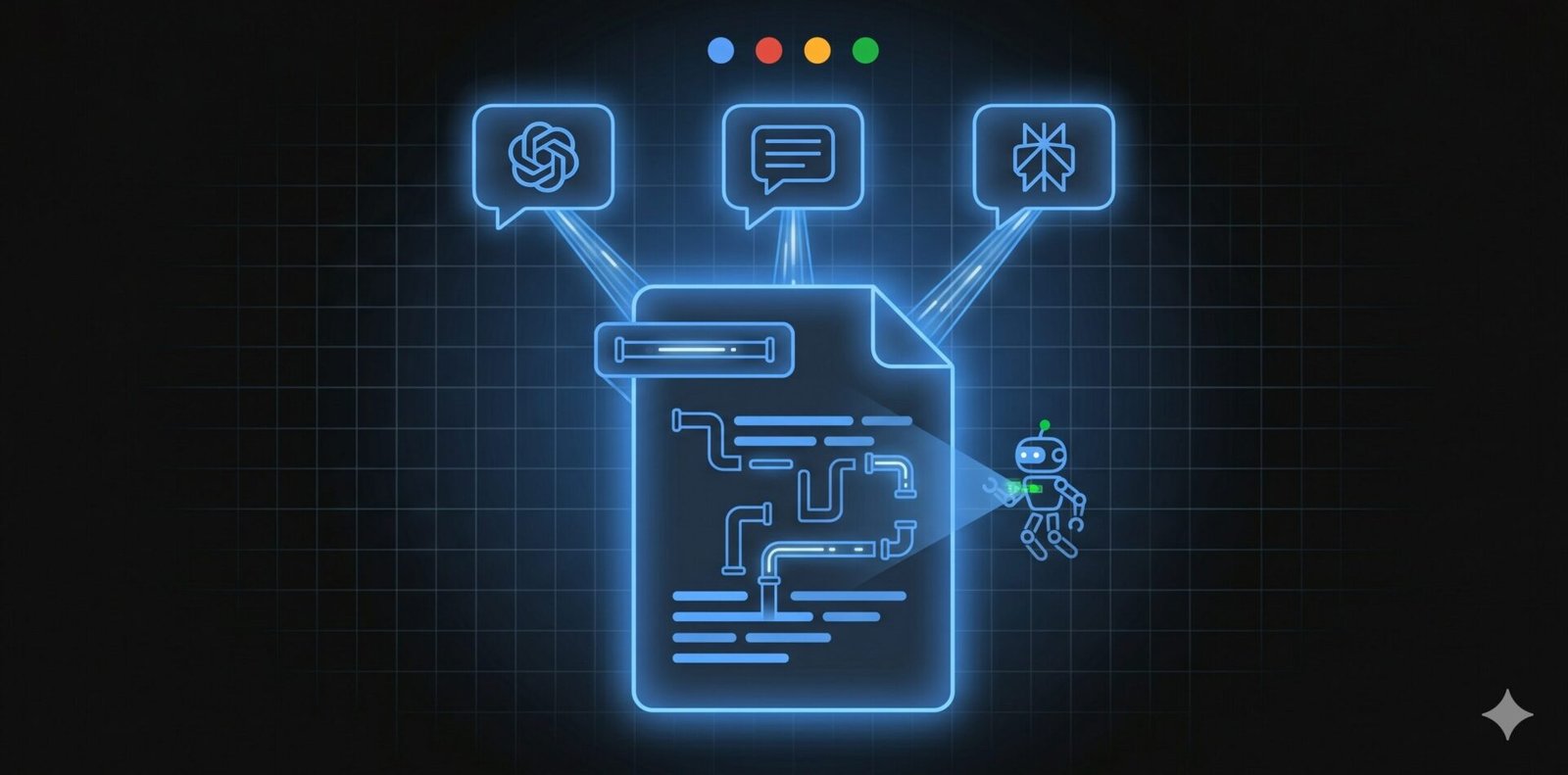
This guide is the diagnostic framework we use at Evolve Media Agency when a brand can't figure out why ChatGPT, Claude, Perplexity, or Gemini won't cite them. Seven layers. Each one maps a specific type of gap. At the end, a priority fix sequence and a 90-day recovery plan you can execute with your existing team. For the broader strategic picture this audit fits inside, see our AI search resource hub.
▶ Watch: The Video Version
Prefer to watch? Here’s the full breakdown.
Why You Need an AI Visibility Audit (And Why Google Analytics Can't Show You the Problem)
Search analytics platforms are built to measure a specific loop: a user types a query, gets a list of links, clicks one, and lands on your site. That loop generates sessions, impressions, clicks, and rankings — all of which your analytics can track.
AI search breaks that loop at step two. When a user asks ChatGPT "what's the best supplement brand for gut health" or asks Perplexity "give me the top three ecommerce agencies for Amazon brands," they may never see a list of links at all. They get a synthesized answer. If your brand is cited, they learn about you. If not, you simply don't exist in that conversation.
This is sometimes called the "zero-click" problem for AI search — but it's actually a zero-visibility problem. The user didn't bounce from your page. They never visited. Your analytics show nothing unusual because nothing happened on your side at all.
45% of consumers now use AI tools for local and product research, up from just 6% in 2025. If you're not measuring AI visibility, you're flying blind on an audience that's growing faster than any other search channel. — Marketing Code, 2026
The only way to measure AI visibility is to go looking for it. That means running structured prompt tests across multiple platforms, auditing the technical and content factors that AI systems use to evaluate your site, and building a baseline "Share of Model" metric you can track over time. That's what this guide teaches you to do.
The 3 Gap Layers: Discovery, Retrieval, and Citation
Before diving into the 7-layer audit, it helps to understand the three fundamental ways AI systems can fail to surface your brand. If any of the terms below are new, our ecommerce AI search glossary defines every concept used in this audit. Every specific gap we'll audit falls into one of these three categories:
- Discovery gaps — AI crawlers can't find, access, or index your content. Your site might as well not exist to the AI. Crawler blocks, robots.txt rules, JavaScript rendering failures, and broken sitemaps all create discovery gaps.
- Retrieval gaps — AI can access your content, but doesn't retrieve it when processing a relevant query. This is usually a content structure problem: your pages don't answer questions in a format AI can extract, your headings don't match query intent, or your pages lack the semantic signals that tell AI they're authoritative on a topic.
- Citation gaps — AI retrieves your content, evaluates it, and then doesn't include it in the final response. This is the hardest gap to close — it requires building entity authority, earning third-party mentions, accumulating review signals, and demonstrating corroboration from sources AI already trusts.
Only 15% of pages ChatGPT retrieves are actually cited in the final response. Getting crawled is table stakes. Getting cited requires clearing all three gap types — not just the first one.
The 7-layer audit below systematically checks your exposure in each category. Layers 1–2 are discovery. Layers 3–5 are retrieval. Layers 6–7 (plus the entity and mention layers) are citation. Most brands have gaps in all three, but the distribution tells you where to focus first.
Layer 1: Crawler Access Audit (Are AI Bots Even Reaching You?)
Before any AI system can cite your content, it needs to be able to read it. This sounds obvious, but 73% of websites have at least one technical barrier blocking an AI crawler — and most site owners have no idea it's there.
Check your robots.txt file at yourdomain.com/robots.txt. Look for any of these crawler agents being blocked:
- GPTBot — OpenAI's training crawler (blocking this doesn't block ChatGPT citations)
- OAI-SearchBot — OpenAI's real-time web retrieval crawler (blocking THIS kills ChatGPT web citations)
- ChatGPT-User — ChatGPT's browsing agent
- PerplexityBot — Perplexity's crawler
- ClaudeBot / Anthropic-AI — Anthropic's crawlers
- Google-Extended — Google's Gemini training crawler
- CCBot — Common Crawl bot (used to train many LLMs)
Also check for blanket User-agent: * disallow rules that block all bots — these hit AI crawlers as a side effect. If your site has login walls, mandatory JS rendering, or aggressive rate limiting, AI crawlers often bounce without indexing anything.
Common Crawler Blocks and How to Fix Them
The most common culprit is a Cloudflare Bot Fight Mode or similar security rule blocking all unrecognized bots. Many ecommerce stores turn this on to reduce scraping and inadvertently block every AI crawler on the list above. The fix: whitelist known AI crawler IPs and user agents in your security rules.
A second common issue is JavaScript-rendered content. If your product pages, FAQs, or category descriptions are loaded dynamically via JavaScript, AI crawlers running a basic HTTP fetch won't see them. Use Google Search Console's URL Inspection tool to render your pages as Googlebot — if the text content doesn't appear fully rendered, AI crawlers are likely seeing the same blank page.
Submit your sitemap.xml to Bing Webmaster Tools today. ChatGPT's web retrieval runs on Bing's index. If Bing hasn't crawled your recent content, ChatGPT can't cite it. Most ecommerce brands never set up Bing Webmaster Tools.
Layer 2: Schema and Structured Data Audit
Schema markup is the language AI systems use to understand your content at a structural level. It's not a ranking factor in the traditional sense — it's a comprehension factor. A page with correct schema is exponentially easier for an AI to interpret, categorize, and cite with confidence than an identical page without it.
Run every key page through Schema.org Validator and Google's Rich Results Test. Check for:
- Organization schema on your homepage — name, URL, logo, description, sameAs (social profiles), contact info
- Article schema on all guide/blog pages — headline, author, datePublished, dateModified, image
- Person schema on your About page — required for author E-E-A-T signals
- FAQPage schema on pages with Q&A sections — massive citation multiplier
- Product schema on product pages — name, description, price, availability, review aggregate
- BreadcrumbList schema on all pages — helps AI understand site hierarchy
- LocalBusiness schema for service businesses with physical locations
Errors to prioritize: missing required properties (especially author on Article schema), conflicting schema from multiple plugins, and incorrect dateModified values (should update every time content changes).
The ROI on schema is disproportionate to the effort. Adding correct FAQPage schema to your 10 most-visited pages takes a developer 2–3 hours. Pages with FAQPage schema are cited 2.8x more often by AI systems than identical pages without it, according to FogLift research (2026). That's one of the highest-leverage technical fixes in this entire audit.
Get Your AI Audit Done Right
We run the full 7-layer audit for ecommerce brands and build the recovery roadmap for you.
Book a Free CallEcom Profit Box
Amazon Listing Checklist, Image Blueprint, and 4 more PDFs — free.
Get Free ResourcesLayer 3: Content Structure Audit (Is Your Content Extractable?)
This is where most ecommerce brands have the most room to improve. AI systems don't read your pages the way humans do. They look for discrete, self-contained passages that directly answer a specific question. They evaluate heading hierarchies to understand what each section covers. They weight statistics that cite a source more heavily than unsourced claims.
For your top 20 pages by organic traffic, check each one against this extraction-readiness checklist:
- Does the page have a clear H1 that contains the primary keyword?
- Does each H2 address a distinct question or subtopic — not just a creative label?
- Does the first paragraph under each H2 directly answer what the heading asked?
- Are there at least 3 attributed statistics with named sources?
- Is there a dedicated FAQ section with 5+ Q&A pairs?
- Are there numbered or bulleted lists that can be "lifted" as complete answers?
- Is the page under 5,000 words? (AI citation rate drops sharply above this threshold)
- Are all claims in the first 30% of the page — where 44% of AI citations are pulled from?
Most brand content is written to persuade. AI needs content written to extract. That gap is the single most fixable source of AI invisibility.
The most common content structure failure we find in audits: answers buried in the middle of long paragraphs. A user asks ChatGPT "how long does it take to rank on Amazon?" and your 3,000-word guide has the answer — but it's the third sentence of paragraph eight of section five. AI's retrieval mechanism never isolated it as a standalone answer. Rewriting that paragraph as a direct answer at the top of a clearly labeled section would fix the problem.
Learn more about writing extraction-ready content in our guide on content structure for ecommerce or explore the full AI Search Visibility Playbook for a broader framework.
Layer 4: Entity Authority Audit (Does AI Know Who You Are?)
An "entity" in AI and search terms is a real-world thing — a brand, a person, a place, a product — that AI systems can confidently identify, describe, and connect to related facts. Brands with strong entity authority get cited because AI has high confidence about who they are and what they stand for. Brands without it get skipped, even when their content is relevant.
Check your entity footprint across each of these touchpoints:
- Google Knowledge Panel — Does your brand have one? Test by searching "[brand name]" on Google. If no panel appears, your entity signals are weak.
- Wikidata entry — A free structured data entry at wikidata.org. This is the fastest entity signal you can add today, with no notability requirement.
- Google Business Profile — Complete with accurate NAP, services, hours, and populated Q&A section.
- About page depth — Does your /about/ page clearly state who you are, what you do, who you serve, and include founding date, team, and Person schema?
- Consistent brand name across properties — Google, Bing, Yelp, social profiles, industry directories should all reference your brand name identically.
Entity authority is an AI confidence signal. The more places a consistent description of your brand appears — and the more authoritative those sources are — the more confident AI is that it knows who you are. That confidence directly correlates with citation frequency. Brands with Wikipedia entries get cited at rates 3–5x higher than identical brands without them.
Layer 5: Third-Party Mention Audit
AI systems build confidence to recommend a brand by looking for corroborating evidence across multiple independent sources. This is the "consensus signal" — if your brand is mentioned favorably in a BuzzFeed listicle, two industry newsletters, a podcast transcript, and a Reddit thread, an AI has much higher confidence recommending you than if only your own website talks about you.
Audit your current mention landscape across each source type:
- "Best of" listicles — Search Google for "best [your product/service category]" and check if your brand appears in the top 10 results. These pages represent 43.8% of ChatGPT citations (Ahrefs data).
- Reddit threads — Search reddit.com for your brand name and your product category. AI pulls heavily from Reddit discussions.
- YouTube videos — Any reviews, comparisons, or mentions on YouTube? YouTube is now the #1 cited social platform in AI answers.
- Press mentions — Any articles from news or industry publications mentioning your brand?
- Podcast appearances — Guest appearances where your brand is discussed and transcribed.
- Backlink-adjacent mentions — Use Ahrefs or Semrush to find unlinked brand mentions that could be converted to links or citations.
Content distributed across third-party platforms generates 325% more AI citations than content published only on your own site (Stacker, 2025). This is why digital PR and off-page mention building has become the highest-ROI AI search investment for most brands. Your own site can't corroborate itself.
For a complete playbook on building third-party mentions, see our Brand Mention Strategy for AI Search guide.
Layer 6: Review and Social Proof Audit
Reviews are an underrated AI citation signal. Brands with active profiles on Trustpilot, G2, Google Reviews, and category-specific platforms (Capterra, TripAdvisor, Houzz, etc.) appear in AI responses at significantly higher rates — not because AI reads each review, but because review platform presence signals legitimacy and real-world customer validation.
Audit your review presence across each relevant platform:
- Google Business Profile reviews — current rating, review count, response rate, recency of last review
- Trustpilot / G2 / Capterra — profile claimed? Rating? Active review velocity?
- Amazon reviews (for product brands) — star rating, review count, verified purchase percentage
- Review schema on your website — AggregateRating markup on product and service pages
- Review velocity — are you consistently receiving new reviews, or did activity stop 12 months ago?
Brands active on 3+ review platforms are 3x more likely to be cited by ChatGPT than brands with a single review presence. — SE Ranking, 2025
Layer 7: Freshness and Activity Audit
AI systems weight recently updated content more heavily for time-sensitive and evolving topics. A comprehensive guide published in 2022 and never touched since carries less citation weight than a slightly thinner guide that was updated three months ago — even if the older guide has more total information.
Check each of these freshness signals:
- dateModified in Article schema — Is it being updated when you refresh content? Many CMS setups don't update this automatically.
- Last-updated dates visible on page — Is the "Last Updated" date prominently displayed in your hero/byline area?
- Stale stats — Are you citing 2022 or 2023 statistics in guides that are supposed to be current? AI can recognize temporal mismatches.
- Google Business Profile activity — When did you last post an update, add a photo, or respond to a review? GBP activity is a freshness signal for local AI citations.
- Content refresh cadence — Do your core guide pages have a scheduled review date, or are they "publish and forget"?
Pages refreshed within 60 days receive 1.9x more AI citations than equivalent pages that haven't been updated in over 6 months, per BrightEdge research. The fastest freshness fix: go through your top 10 content pages, update any statistics, add 2–3 new paragraphs, update the dateModified schema, and republish. Takes 30–45 minutes per page.
The Share of Model Calculation: Your AI Visibility Baseline
Share of Model (SOM) is the AI-era equivalent of share of voice. It tells you what percentage of AI responses in your category mention your brand. It's the single metric that most clearly captures your AI visibility — and it's the baseline you'll track as you execute your recovery plan.
How to Calculate Your SOM
- Build a 30-Prompt SetCreate 30 prompts across three categories: 10 high-intent purchase queries ("best [product type] for [use case]"), 10 comparison queries ("[your brand] vs [competitor]", "[competitor] alternatives"), and 10 informational queries in your category where you want to be cited as a source.
- Run All 30 Across 2+ AI PlatformsTest every prompt in ChatGPT (with web browsing enabled), Perplexity, and optionally Claude and Gemini. Record the full response for each. This gives you 60–120 data points.
- Count Brand MentionsGo through every response and count: (a) how many mention your brand, (b) how many mention each competitor, (c) the sentiment of each mention (recommended, neutral, warning).
- Calculate SOMDivide your total brand mentions by the total number of responses. If your brand was mentioned in 12 out of 60 responses, your SOM is 20%. Track this monthly.
- Benchmark Against CompetitorsRun the same calculation for your top 3 competitors. The competitor with the highest SOM is your target. Reverse-engineer why their content, schema, or mention profile is outperforming yours.
Tools like Otterly.ai, Profound, and Peec AI automate this process and track your SOM over time without manual testing. If you have the budget, these cut the measurement overhead dramatically and let you track dozens of prompts daily across multiple AI platforms.
Running the Multi-Platform Prompt Test (The 30-Query Method)
The prompt test is more than just a measurement exercise. It's a qualitative intelligence tool. When you read how AI systems describe you (or your competitors), you get a window into exactly what content and signals the model is drawing on — which tells you directly where your gaps are.
What to Look For When You Run Prompts
- Which source does the AI cite for each claim? If it's citing a competitor's blog post for something you should own, you know what content to create or upgrade.
- What attributes does AI use to describe your brand? If the description is thin, vague, or missing specific differentiators, your entity signals and content are underperforming.
- Which platforms produce the most favorable responses? If Perplexity cites you but ChatGPT doesn't, Bing indexing (which feeds ChatGPT) is likely the gap.
- Are mentions positive, neutral, or qualified? A mention that says "some users report issues with" is worse than no mention at all. Review your review platforms and brand sentiment.
- What prompts trigger your competitors but not you? These reveal exactly which content gaps to close first.
Run this test quarterly at minimum. AI models update regularly, and a prompt that cited you last quarter may not cite you now — or vice versa. The goal is consistent, improving SOM over time, not a one-time win. Learn how to build a proper tracking system in our AI Search Visibility Playbook.
Competitor Gap Analysis: Why They Get Cited and You Don't
The fastest way to close your AI visibility gap is to study the brands that already have the visibility you want. When a competitor gets cited in a response where you don't, that's signal — not just noise. Something about their content, schema, entity profile, or mention network is outperforming yours on that specific prompt.
The 5-Minute Competitor Citation Analysis
When you find a response that cites a competitor and not you:
- Identify which specific URL the AI cited (if a source link is provided). Visit that page.
- Check the H1 and lead paragraph — is it answering the query more directly than your equivalent page?
- Look for FAQ sections, numbered steps, or attributed statistics that you're missing.
- Check their schema using Schema.org Validator — are they running Article + FAQPage + Organization that you're missing?
- Check their third-party mention profile — search "[competitor name]" on Google and count how many "best of" listicles, press mentions, and review platforms mention them.
The competitors most likely to dominate AI citations in ecommerce are not necessarily the biggest companies. They're the ones with the most extraction-ready content structures and the most diverse third-party mention profiles. A mid-sized brand with excellent FAQ schema and consistent Reddit/YouTube presence will consistently out-cite a larger brand with weak on-page structure.
Use this analysis to build a prioritized content hit list: pages where a relatively small structural improvement would move you from "not cited" to "cited." These are your quick wins.
The Priority Fix Order: Which Gaps to Close First
Most brands find multiple gap types in their audit. Here's the sequencing logic for maximum ROI — highest impact fixes first, building on each other:
Don't try to fix everything at once. Brands that execute fixes in this sequence see measurable SOM improvements within 30–60 days of starting. Brands that scatter their effort across all 7 layers simultaneously typically see minimal results in any of them.
Your 90-Day AI Visibility Recovery Plan
Here's the execution roadmap. Sequence matters — each phase builds on the previous one.
- Audit and fix robots.txt crawler access
- Submit sitemap to Bing Webmaster Tools
- Add Organization schema to homepage
- Add Article + FAQPage schema to top 5 pages
- Create or complete About page with Person schema
- Run baseline 30-query SOM calculation
- Fix any JavaScript rendering blockers
- Restructure top 3 content pages for extraction
- Add FAQ sections to product pages
- Create or claim Wikidata entry
- Complete Google Business Profile
- Claim profiles on 2–3 review platforms
- Update dateModified on all refreshed pages
- Identify 5 "best of" listicles to target for inclusion
- Outreach to 5 "best of" listicle sites for inclusion
- Pitch 1–2 podcasts in your niche for guest appearances
- Activate review request email sequence for past customers
- Post first update to Google Business Profile
- Run 30-query SOM again — compare to baseline
- Prioritize next 5 content pages to restructure
- Set 90-day content refresh calendar for core pages
In our experience, brands that execute all three phases consistently see 15–40% SOM improvement within 90 days for their core keyword categories. The brands that see the largest gains are typically those coming from the weakest baselines — especially those that discover they had crawler blocks or zero schema in the audit.
If you want to move faster or need help executing any part of this audit, our team at Evolve Media Agency runs full AI visibility audits and builds out the recovery roadmap for ecommerce brands. We also handle the technical schema work, content restructuring, and digital PR components if you'd rather not manage it in-house.